
Fillmore County Arrest to Court
The local path starts with arrest and booking at the Fillmore County Jail. The Fillmore County Sheriff's Office, led by Sheriff John DeGeorge, operates the jail side of that process. The sheriff's roster may then list a person as in custody with a photo, MNI, booking number, intake date, charge rows, and bail or bond fields. Those roster charges are useful for a first check, but they are not the final court record. The Fillmore County Attorney reviews the reports and decides what criminal complaint or other charge document to file. Once that filing occurs, the case belongs to Fillmore County District Court in Minnesota's Third Judicial District.
For custody and booking detail, the Fillmore County jail inmate records page is the better record path. For booking photos, use the Fillmore County jail mugshots page. Court records after a jail arrest focus on filed charges, hearing dates, bond orders, warrants, public documents, and case outcomes. A person can be booked on one description and later face amended, reduced, or dismissed charges in court, so the court case should be checked before drawing conclusions.
Fillmore County Court Details
Fillmore County District Court is located at the Fillmore County Courthouse, 101 Fillmore Street E., Preston, MN 55965. The court phone is 507-765-6021, the fax is 507-765-5228, and the court administrator listed in the research is Jordan Marcou. Court business hours are Monday through Friday, 8:00 a.m. to 4:30 p.m. Public parking is described by the court as available in the lot on the east side of the courthouse and on the street.
The court's related-agency contact page adds useful numbers for court records after an arrest: Court Services or Probation at 507-765-3667, County Attorney at 507-765-2530, Sheriff and Jail at 507-765-3874, Victim Services at 507-765-2805, and the Rochester public defender office at 507-285-7370. Those contacts do different jobs. The court maintains the public case record. The jail answers current custody questions. The prosecutor handles charging decisions for county prosecutions. For law-enforcement records that are not in MCRO or the live custody table, the Fillmore County Sheriff's Office services page is the local data-request route.
The source image for the local court contact information is the official Fillmore County District Court page.
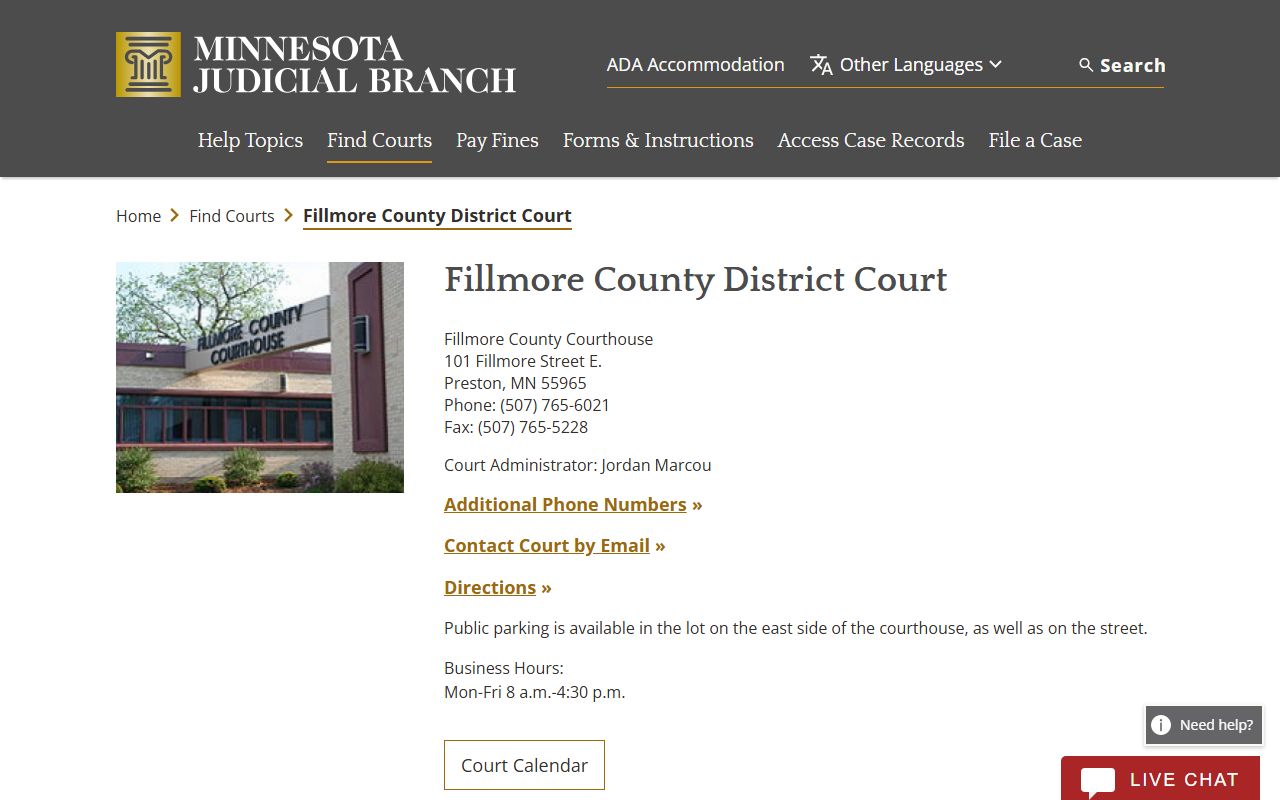
That court page is the local anchor when MCRO does not answer a case-timing, hearing, or public-file access question.
Fillmore County Court Record Search
Minnesota Court Records Online, usually called MCRO, is the public case-search system for Minnesota district courts. The MCRO Case Search can be used to search Fillmore County criminal cases by name, case number, citation number, or attorney. It is not the jail roster, and it does not replace a custody call when release status is urgent. Its main value after a Fillmore County jail arrest is that it can show the public court case, filed charges, hearing events, public documents when available, judgments, and case status.
Start with the person's full name from the roster. Note the intake date, charge description, statute number, booking number, and any bond amount shown by the jail. Then search MCRO by person name and narrow the court location to Fillmore County when possible. If no case appears right away, the reason may be simple timing. Booking can occur before the Fillmore County Attorney files a complaint, and MCRO will not show a formal court case until the case exists in the court system.
The MCRO search screen used for Fillmore County court records after arrest is captured from Minnesota Court Records Online Case Search.
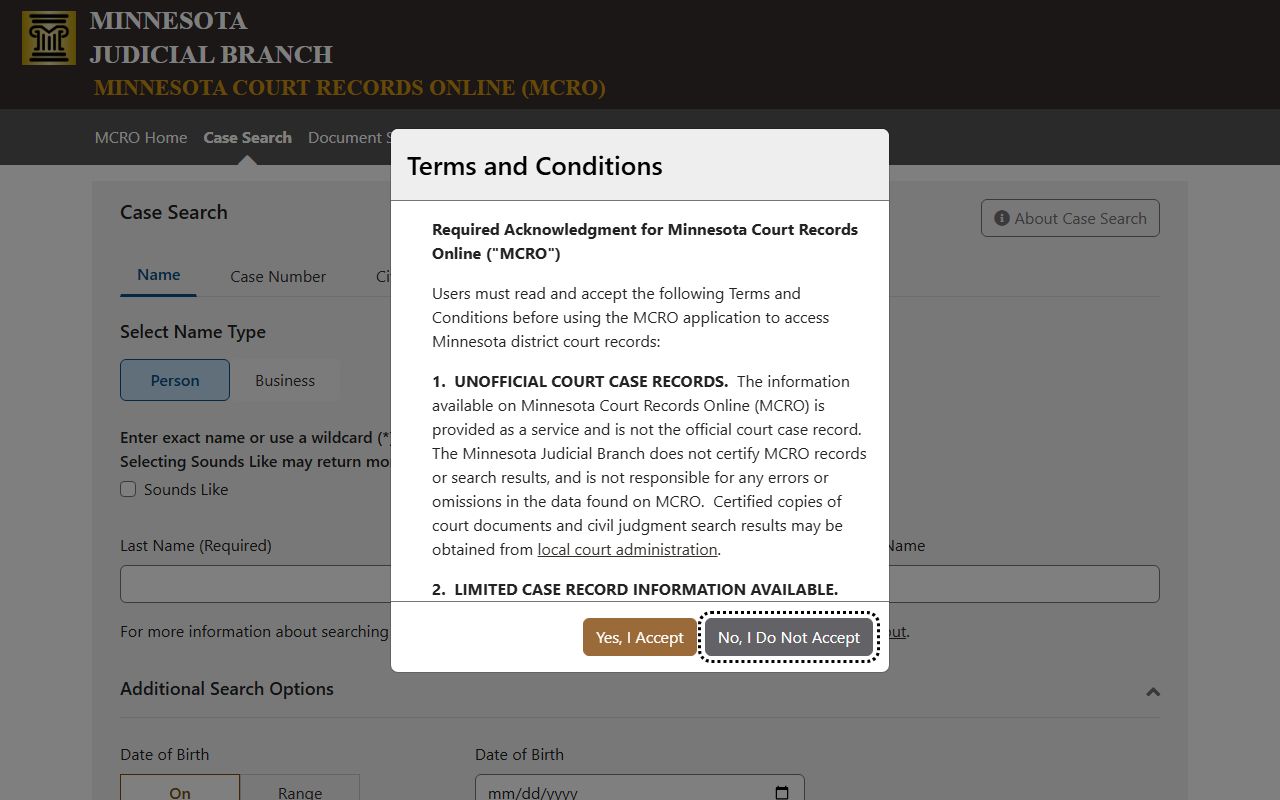
The search fields matter because a name-only search can return people from other counties unless the court location is narrowed.
| Field Label | Type | Required | Options / Format Notes |
|---|---|---|---|
| Main tabs | Tab buttons | One | Name, Case Number, Citation Number, or Attorney. |
| Name Type | Tab buttons | Yes for name search | Person or Business. |
| Sounds Like | Checkbox | Optional | Wildcards are not allowed when Sounds Like is used. |
| Last Name | Text | Yes for person search | Exact name or trailing wildcard after two characters. |
| First Name | Text | Yes for person search | Exact name or wildcard. Required in person search. |
| Middle Name | Text | No | Optional field to narrow common names. |
| Date of Birth | Date / radio | Optional | Exact date or range in MM/DD/YYYY format. |
| Date Filed | Date / radio | Optional | Exact date or range. |
| Case Category | Checkboxes | Optional | Civil, Criminal, Family, Probate, or Mental Health. All are checked by default. |
| Case Status | Dropdown | Optional | All, Active, or Inactive. |
| Court Locations | Radio and county checkboxes | Optional | Statewide or County. Select Fillmore County to narrow results. |
| County Search | Text | Optional | Fillmore appears in the county list with value 120. |
Fillmore County Charging Records
After a Fillmore County arrest, the charging record begins when the prosecutor files a document that starts or advances the criminal case. For ordinary county prosecutions, the public user most often sees a complaint, along with a register of actions, hearing notices, orders, and a disposition if the case reaches one. An information or indictment can appear in other procedural contexts. The terms are worth separating because jail booking data, prosecutor filings, and final court results are different records.
| Document | Who Uses It | What It Does | What to Check |
|---|---|---|---|
| Complaint | Prosecutor | Lists the alleged offenses and facts used to start many Minnesota criminal cases. | Charge level, statute, probable-cause text, and filing date. |
| Information | Prosecutor | Formal charging document used in certain procedural settings. | Whether it replaced or narrowed earlier charges. |
| Indictment | Grand jury | Formal accusation returned by a grand jury, often tied to serious cases. | Counts, dates, and later amendments. |
Fillmore County uses the Minnesota title County Attorney, not District Attorney. County Attorney Brett Corson is listed at 101 Fillmore St, P.O. Box 466, Preston, MN 55965, with attorney@co.fillmore.mn.us and 507-765-2530 in the county contact directory. The County Attorney's role after a jail arrest is to review reports, file appropriate charges, handle prosecution, and work with victim-related interests during the court process.
Fillmore County Charge Status
Charge status can change as a case moves. A roster may show COURTPENDING or SENTENCED in a jail charge row, while MCRO may show active or inactive case status and separate events in the register of actions. Read both systems in sequence: the jail row explains current custody and booking data; the court record shows filed charges, hearings, orders, and disposition. If those details conflict, call the court or jail rather than relying on a stale screen.
| Status | Plain Meaning | Why It Matters |
|---|---|---|
| Pending / court pending | The court case or charge still awaits hearing, plea, trial, dismissal, or sentence. | No conviction should be assumed from a pending charge. |
| Amended | The prosecutor or court changed the charge wording, count, level, or statute. | Older roster text may no longer match the filed case. |
| Reduced | A charge was lowered to a lesser offense or level. | The final exposure may differ from the booking charge. |
| Dismissed | The charge was ended without a conviction on that count. | Dismissal may affect expungement options, but it does not erase all public traces by itself. |
| Convicted / sentenced | A guilty plea, verdict, or sentencing result has been entered. | State prison transfer may move lookup from the county roster to MNDOC. |
Fillmore County Bond Records
Fillmore County's live custody table publishes bond information inside each row, with labels for Amount \ With Conds, Bail Received, and Bond Received. The county also warns that roster data may not be current, accurate, or complete at a given time. Before anyone posts money, the practical route is to call the jail at 507-765-3874 and, when court action is involved, Fillmore County District Court at 507-765-6021. Ask for the exact amount, case number, payment location, accepted payment method, court conditions, and any other hold.
| Release Term | How It Works |
|---|---|
| Cash bail or bond | Money is posted when allowed by the court order. The exact location and method should be confirmed before travel. |
| Conditional release | Release depends on rules such as no contact, testing, no alcohol, stay-away terms, or required appearances. |
| Unconditional amount | Some Minnesota orders list a higher amount with no conditions and a lower amount with conditions. |
| Surety bond | A commercial bond may be accepted in some cases, but the court order controls. |
| PR release | Personal recognizance means release on a promise to appear, often with stated conditions. |
| No-bond hold | No release amount is available until a judge, warrant, or other agency hold is resolved. |
Hold status can be the detail that changes the answer. A person may satisfy a Fillmore County bond and still remain in custody because of a warrant, DOC hold, federal matter, immigration hold, or another county's request. That is why the jail record, MCRO case record, and direct phone confirmation all matter.
Fillmore County Warrant Records
No official Fillmore County active warrant database was located in the county sources reviewed. Warrant questions therefore use a fallback chain: call the sheriff or jail at 507-765-3874, contact Fillmore County District Court at 507-765-6021, search MCRO by name or case number, and use the sheriff's data-request process for public law-enforcement data that is not online. The sheriff contact page says dispatch operates 24 hours a day and callers can choose option #1 for a dispatcher or deputy.
- Arrest warrant
- A court order authorizing arrest on a criminal complaint or other court action.
- Bench warrant
- A warrant issued by a judge, often after failure to appear or violation of a court order.
- Search warrant
- An order authorizing a search. It is not the same as a custody hold.
- Hold warrant
- A warrant or detainer from another county, state, federal, or immigration agency that may block release.
If a warrant leads to a Fillmore County arrest, the person may appear on the current custody table after booking. The table may show charge data, but MCRO is the better place to connect the warrant to a case number, hearing, and court order. Absence from the roster should not be treated as proof that no warrant exists.
Fillmore County Charge Records
Arrest, charge, and conviction are separate events. A person can be arrested and booked, then not charged. A person can be charged, then have a count dismissed or amended. A conviction requires a guilty plea, verdict, or other court disposition that resolves the charge as a conviction. Court records after a jail arrest should be read with that sequence in mind.
| Point of Comparison | Charge | Conviction |
|---|---|---|
| Stage | An accusation filed or listed before final outcome. | A final criminal result based on plea, verdict, or judgment. |
| Proof level | Starts from probable cause or charging review. | Requires proof beyond a reasonable doubt or a guilty plea. |
| Record location | May appear on the jail roster and in MCRO. | Appears in the court disposition and may affect DOC records if prison follows. |
| Use in judgment | Should not be treated as guilt. | Can support sentence, supervision, fines, and collateral consequences. |
Fillmore County Sealed Records
Minnesota expungement law is the main records-clearing path after an eligible dismissal, acquittal, diversion result, sentence, or waiting period. Minn. Stat. 609A.015 covers automatic expungement eligibility for some records, and Minn. Stat. 609A.03 covers the petition process. The Minnesota Attorney General's expungement guide explains the process in public-facing terms. Fillmore County sources did not publish a local policy that promises automatic removal of all jail or court traces after dismissal.
| Point of Comparison | Sealed | Expunged |
|---|---|---|
| Public visibility | Hidden from ordinary public access by rule, order, or statute. | Often used in Minnesota to mean sealed from public access, depending on the statute or order. |
| Agency access | Some agencies may still see or use sealed data for permitted reasons. | Access can still exist for defined criminal-justice or statutory purposes. |
| How it happens | By statute, court rule, confidentiality category, or court order. | Through automatic eligibility or petition under chapter 609A. |
| Practical limit | Does not always erase copies already lawfully released. | Does not guarantee removal from every third-party copy. |
Juvenile records, sealed charges, confidential documents, and active investigative data may not appear in MCRO. Minnesota law also allows law-enforcement agencies to withhold certain data when public release would harm an active investigation. Public court records should be verified with the originating court before they are used for any serious decision.
Victim and VINE Notices
Victim-related questions belong with the prosecutor, victim services, court, or VINE depending on the issue. Fillmore County court contact material lists Victim Services at 507-765-2805. The jail and PREA material also lists the Victim Services Center of Dodge, Fillmore and Olmsted Counties at 507-765-2805 during weekday hours and 507-289-0636 for a 24-hour line. Those contacts are separate from a case search.
Minnesota VINE can send custody and criminal-case notifications. The jail FAQ lists 877-MN-4-VINE and 877-664-8463. VINE is useful after a warrant arrest or custody change, but it is not a complete court file and should not be the only safety plan.
Important: Public case searches are not consumer reports and should not be used for employment, tenant, credit, insurance, or other FCRA-covered decisions.